

 |
Tempting Textures --- Hellebores also known as the Christmas Rose or Lenten Rose or Corsican Hellebore | Hellebores can be spotted in Herby Hillock in the Winter months. Look out for our stunning Hellibores with their dark green waxy leaves and beautifully elegant white flowers. Most of ours are the largest species with big creamy pale almost green flowers and thick leathery foliage. Hellebores also grow in gentle shades of pink, plum, soft green and deep purple. Hellebores will usually flower from Winter right through into early Spring. They love shady spots but they do not like the soil to be too dry or too moist. --- Did you know? Hellebores are actually related to the buttercup family of plants even though their common name is Christmas or Lenten rose. |
 |
Robust and Reliable --- Pachysandra also known as Japanese spurge | Pachysandra can be recognised by its low growing mats of glossy dark green leaves. These plants have interesting leaves with serrated edges. In Early Summer you will be able to see tiny white flowers contrasting against the dark leaves. --- Did you know? Pachysandra is a really useful for under planting patches of ground below shrubs and roses. |
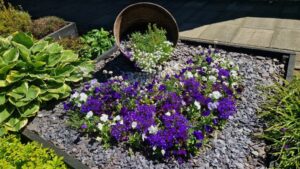 |
Washtub donated by ‘Dunse Historical Society’. | We hope to continue planting this area with blue and white flowers tumbling out depicting soap suds flowing. |
 |
Fabulous Fragrance --- Marjoram | Marjoram has a lovely floral woody smell when gently crushed or warmed in the sunshine. Like Thymes, it is an herb used for culinary flavouring. It has teeny clusters of oval leaves that grow in pairs and tiny pink flowers much loved by pollinators. --- Did you know? Marjoram is often confused with another herb called Oregano because they look very similar. Oregano has a stronger more spicy taste. |
 |
Fantastic Foliage --- Hostas also known as Plantain lilies | Hostas are incredible foliage plants. These stunning tall clump forming plants have long upright sword like or slightly arching leaves. They also send up tall stems of lilac, cream, purple or pale blue flowers in the Summer. Hostas thrive in shade and also grow well in containers. Hostas come in a huge range of leaf colours. Most are large, heart shaped and dramatic either in size or leaf texture. They grow in variegated colour combinations of greens, yellows, creams and even grey blues. --- Did you know? There is even a pure creamy white Hosta called ‘White Feather’. Slugs and snails love to eat Hosta leaves. |
 |
Fantastic Foliage --- Phormium also known as New Zealand Flax | Phormiums are evergreens. They come in many shades of yellow, greens, reds and purple. They are often stripy and variegated. In the summer you may spot tall leafless stems bearing tubular flowers. You may also have seen some Phormium in our Castle Corner bed. Named ‘Jester’, it is spectacular and you can see how it got its name! Look for very tall arching sword like pink leaves with green stripes. The Summer flowers on 'Jester’ are red on tall leafless stems. Be careful they can be sharp and spikey. --- Did you know? Phormiums originate in New Zealand. They have traditionally been used for rope making and weaving . They don’t always like the frost so may need protecting in harsh weather. |
 |
Seasonal Showstopper --- Ericas also known as Heath or Heather Erica | Ericas are small evergreen shrubs with long lasting colour. They brighten up our beds in Winter when there is not much else in colour. We have chosen our Ericas to create a lovely blanket of colours. Look for tiny needle like leaves covered in small bell shapes flowers. We know that these are Erica ‘Estrella Gold’, ‘Alba Mollis’ and ‘Cranberry Road’ and you will spot their gold, white and burgundy flowers. --- Did you know? Ericas are moor and heathland plants so they prefer their soil to be acidic. |
 |
Seasonal Showstopper --- Bergenia also known as Elephant’s ears | Bergenia .It’s easy to spot why these are called ‘Elephant’s ears’. Look for big dark green glossy rounded leathery leaves. In Spring you will also see sturdy reddish stems topped with tiny pinkish clusters of bell like flowers attracting early pollinators. --- Did you know? Bergenias are evergreen so their bold leaves look good all year round. |
 |
Beautiful Bulbs --- Daffodil also known as Narcissus | Daffodils. In the Springtime you will enjoy our selection of pale lemon daffodils. They are grown from bulbs, and once planted Daffodils will return year after year and gradually spread. This spreading is called ‘naturalising’. Daffodils have slim green leaves and a straight slim stems topped by bright trumpet shaped flowers, usually orange, white or yellow surrounded by six petals. --- Did you know? Daffodil bulbs are toxic but are easily mistaken for onions so never plant them in vegetable plots. |
 |
Beautiful Bulbs --- Tulips also known as Tulipa | Tulips. In the Springtime you will enjoy an incredible display of bright orange Tulips. Tulips are grown from bulbs, and once planted, most Tulips will return year after year and gradually spread. This spreading is called ‘naturalising’. You will spot the Tulips with their broad strappy green leaves, straight stems and cup like flowers. Tulips also grow well in pots. --- Did you know? Many people think that Tulips originate from Holland. In fact they were first imported to Holland from the Ottoman Empire (now Turkey) in the 16th Century. |
| Herbaceous Hide Upper Bed link |
Disclaimer
Our plants are grown for ornamental purposes only. We do not advise touching or ingesting any parts of the plants on the Duns Flowerbed Trail. Many plants can be an irritant or toxic when smelt, ingested or touched. All the ‘Did you know?’ information about alternative plant use is provided for educational interest only.
Continue along the main road heading out of town. The Fire Station will be on your right. Head down the hill. Herbaceous Hide Upper and Lower beds are at the bottom of the hill.